
"estimated output"
400 article(s) found

Ivory Coast coffee production is expected to increase by 1.67 million tons per year.
Xinhua News Agency, Dakar, reporter Huang Yanguang reported: the Ivorian government recently said that this year, Ivorian coffee cocoa is generally growing well, with an estimated output of 1.67 million tons, an increase of 120000 tons over last year, and revenue is expected to reach 308 billion West African francs (470 million euros). Ivory Coast has a bumper harvest of coffee and cocoa, mainly due to the favorable climate this year. In 2013, C ô te d'Ivoire exported coffee cocoa 130
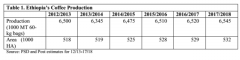
Annual report on Ethiopian Coffee 2017
Ethiopia's coffee production is expected to remain at 6.545 million bags in 2017 / 18. The export is expected to be 3.31 million bags. In June this year, in order to stimulate exports, the government plans to reform the coffee marketing and trading system, one of the most anticipated is that coffee will no longer have to go through the Ethiopian Commodity Exchange (ECX) (ECX trading process and system principles are described in the next article.

Regional characteristics of Pu'er Coffee production area introduction of Pu'er Coffee Flavor characteristics introduction of Pu'er coffee quality
Professional coffee knowledge exchange more coffee bean information Please pay attention to coffee workshop (Wechat official account cafe_style) soil and water climate suitable for growing coffee after Simao government and Nestle had initial contact in 1988, experts from the Chinese Academy of Sciences in mainland China and Yunnan Academy of Agricultural Sciences were invited to hold a discussion meeting, and it was concluded that Simao is quite suitable for growing coffee regardless of water quality, soil, altitude and climate. Nestle nesting

Current situation of coffee industry in Colombia _ flavor characteristics of Colombian coffee _ how much is Colombian coffee
Professional coffee knowledge exchange more coffee bean information please follow the coffee workshop (Wechat official account cafe_style) Colombia as newly planted coffee trees reached their peak and coffee production remained strong in good weather. Production estimates for 2016 / 17 are revised to 14.5 million bags (60kg per bag), 3.6 per cent more than the previous estimate of 14 million bags. If the weather conditions are normal, it is expected to be 20.

Is there a distinction between male and female Coffee beans in Thailand? a brief History of Coffee in Thailand
Professional coffee knowledge exchange more coffee bean information Please pay attention to the coffee workshop (Wechat official account cafe_style) Coffee beans are not male and female. A few years ago, this view became popular in various tourist attractions in Southeast Asia. Later, someone traced the source to a tour guide in Bali. They described round beans as male beans and flat beans as female beans, so as to entice tourists to buy cheaper coffee at a high price.

Supply is in short supply for years, inventory may fall for 8 years, and the price of coffee is afraid to rise.
Do you like coffee? be careful that the price of coffee goes up quietly! Coffee supplies have been in short supply for four consecutive years and inventories have plummeted, and analysts have warned that prices could fluctuate sharply in the coming months. AgriMoney and the Financial Times reported that Robobank predicted that the global coffee production shortage would increase from the previous estimate of 2.5 million tons to 2.8 million tons in 2017-18, mainly due to increased global consumption, Brazil and India.

When the density of Taiwanese cafes exceeds Paris, the black gold trend has endless business opportunities
According to statistics from the International Coffee Organization, the world drank an average of 2 billion cups of coffee a day in 2014, and if estimated at retail prices, the annual output value of coffee has already exceeded 100 billion US dollars. Therefore, coffee is called black gold industry, and it deserves it. Interview = Lin Zhengwen, Chen Yunzhu Author = Lin Zhengwen in David. David T. Courtwright) was written.

Coffee culture the emergence of coffee demand in Europe began in the 17th century.
In the 17th century, there was a demand for coffee in Europe and began to import small quantities of roasted coffee beans from Yemen. In the 18th century, with the fragrance of European cafes and the sharp increase in coffee bean consumption, the Yemeni mocha alone was no longer enough. It is estimated that the output of coffee beans in Yemen in 2007 ○○ is about 20, 000 tons, which is stretched to meet the rising demand of Europe. The price of beans is high and the port of Mocha is busy.

Coffee culture the emergence of coffee demand in Europe began in the 17th century.
In the 17th century, there was a demand for coffee in Europe and began to import small quantities of roasted coffee beans from Yemen. In the 18th century, with the fragrance of European cafes and the sharp increase in coffee bean consumption, the Yemeni mocha alone was no longer enough. It is estimated that the output of coffee beans in Yemen in 2007 ○○ is about 20, 000 tons, which is stretched to meet the rising demand of Europe. The price of beans is high and the port of Mocha is busy.

Flavor and taste characteristics of Tanzanian coffee with pure flavor introduction of fine coffee in manor producing area
Pyrethrum: mainly planted by small farmers, the planting area is distributed in the southern highlands of Mbeya District and Iringa District. The annual output is estimated at 2500 tons. The centralized management department of the industry is the Tanganyika Bureau of exterminating Chrysanthemum. Oil crops: non-traditional crops, including industrial and oil crops, such as castor, sunflower, peanut, sesame, coconut, cottonseed and soybean. Many provinces are suitable.

The emergence of coffee demand in Europe began with the history and culture of coffee in the 17th century.
In the 17th century, there was a demand for coffee in Europe and began to import small quantities of roasted coffee beans from Yemen. In the 18th century, with the fragrance of European cafes and the sharp increase in coffee bean consumption, the Yemeni mocha alone was no longer enough. It is estimated that the output of coffee beans in Yemen in 2007 ○○ is about 20, 000 tons, which is stretched to meet the rising demand of Europe. The price of beans is high and the port of Mocha is busy.
Annual report on Nicaraguan Coffee 2017
Foreword Nicaragua's coffee production in 2016 / 2017 is estimated at a record 2.3 million bags, an increase of 7 per cent over the previous year. The rainy season is responsible for the increase in production, causing coffee trees to blossom earlier and begin to bear fruit. For 2017 / 2018 degrees, assuming good weather conditions, the forecast for the coffee sector will be very close to this year's production.
Indonesia's coffee bean exports will drop sharply to a two-year low, domestic demand will increase and rainfall will affect the harvest.
The number of coffee beans exported from Indonesia will fall sharply to its lowest level in two years, mainly due to increased purchases by domestic coffee bean processors and falling harvests due to rain. According to the median estimate of seven coffee exporters and one processor surveyed by Bloomberg, the country's coffee bean exports may be 14.385 million metric tons (6.42 million bags) lower than a year ago. India
Drought or "death of thirst" hidden worries of expansion behind the disorderly competition of ten thousand mu coffee in Baoshan, Yunnan Province
The continuing drought has hit the coffee industry in Baoshan, Yunnan Province, one of China's largest coffee producers. According to a survey data of Longyang District Hot work Station in Baoshan City, at present, only in Longyang District, the affected area of coffee has reached 66395 mu, and 16321 mu of coffee is facing no harvest. In addition to the impact of the drought, the low price of coffee also worries many farmers.
Pu'er Speed up Coffee Industry
"by 2016, the planting area of coffee in Pu'er City will reach 1 million mu, the output will be about 100000 tons, and the comprehensive output value of the coffee industry will reach 10 billion yuan." Lu Han, director of the coffee office in Pu'er City, Yunnan Province, said.
Burundian coffee
Burundi is located in central Africa with a pleasant climate. Arabica coffee beans grown in the mountains of north-central Africa are of high quality and have won first prize and sixth place respectively in the coffee quality rating of Southeast African countries and the Paris Coffee Fair. According to the annual production of coffee beans in this country, the annual output is between 8000 and 35,000 tons, which is mainly sold to Europe.

Yunnan Coffee suffers from the embarrassment of increasing production but not increasing income of Coffee beans grown in China
It is the 2015-2016 harvest season in Yunnan, and according to the Yunnan Coffee Industry Association, Yunnan coffee production will reach about 130000 tons this year. Due to the recent decline in futures prices in New York, Yunnan coffee will once again experience an increase in production if it continues to follow the previous acquisition practice of subtracting 1020 cents from the New York futures price.
After the drought in Yunnan affected the production of 30,000 mu of coffee for many years, the price went down again.
The continuous drought in Yunnan Province has had a great impact on the important local coffee industry. Data released by the Yunnan Coffee Association show that due to the impact of drought, about 30,000 mu of coffee in Baoshan and other places has been affected, which may lead to a 5% to 10% reduction in coffee production in the province, with an estimated economic loss of tens of millions of yuan. Simaomu, a subsidiary of Starbucks Aichi Coffee (Yunnan) Co., Ltd. (hereinafter referred to as Aichi Coffee).
The largest exporter of coffee in Yunnan
According to the Yunnan Coffee Association, South Korea imports an average of 2000 tons of coffee from Yunnan every year, making it the largest exporter of coffee from Yunnan. Yunnan Province has an area of more than 800,000 mu of coffee, with an annual output of more than 60,000 tons, accounting for 98 percent of the country's total. The products are sold in 31 countries and regions, including the United States, South Korea, Southeast Asia, and so on. South Korea has become the largest exporter of Yunnan coffee because of its market and tariff advantages.

China's coffee output will double in the next five years
Executives at Volcafe, the coffee arm of EDF Man, the UK commodities trader, say annual coffee production in China will double in the next five years and may increase again if demand is sufficient and prices allow coffee farmers to make a profit. Volcafe announced last month the establishment of a joint venture in China's Yunnan Province. As traditional coffee producing areas suffer from diseases, insect pests and droughts, the supply is increased.